




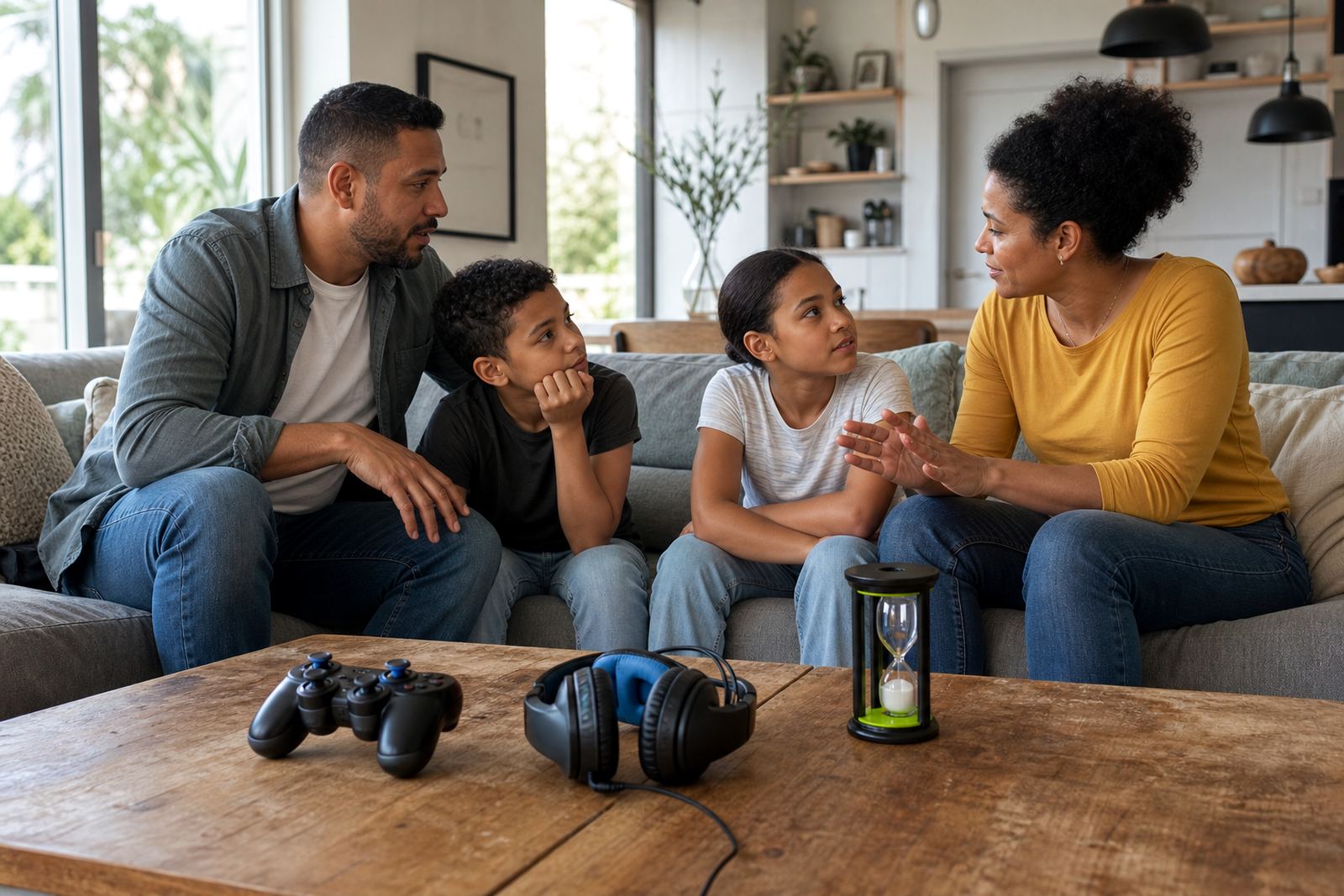
Start With One Honest Family Conversation
Before you write anything down, sit together and talk about how screens are used in your home now. Keep it simple. Ask what feels fair, what causes arguments, and where the biggest pressure points are, such as homework time, bedtime, meals or weekends.
Begin with the basics: who uses which devices, what each device is for, and where it is kept during the day. A good plan does not need long rules. It needs clear ones. For younger children, parents usually make more of the decisions. For teens, the plan should include their input so they understand the reason behind the limits, not just the rule itself.
A useful first step is to write down the three biggest goals for your family. For example: better sleep, less conflict at meals, or more time for sport and reading. Those goals make the rest of the plan easier to shape, and they keep the focus on family life rather than just policing devices.
Set Screen-Time Limits That Match Real Life
Your limits should fit age, school demands and daily routines. A family media plan works best when it covers weekdays and weekends separately. It can also help to distinguish between schoolwork, communication, entertainment and gaming, because not every screen use needs the same boundary. A child doing homework on a laptop does not need the same rule as someone scrolling through short videos at 9 pm.
Many families find it easier to use time blocks instead of only counting minutes. For example, screens may be allowed after homework, after chores, or after outdoor play. That approach often makes the plan easier to follow than a loose instruction like “less time on the phone”. If you need stricter control, use app settings and device tools to set daily limits, bedtime cut-offs and app restrictions.
Check your plan against the ordinary parts of your week. If not, adjust it. A plan that only works on perfect days will usually be ignored on busy ones.
- Set separate rules for school days and weekends.
- Decide what counts as entertainment, study and messaging.
- Agree on a bedtime cut-off for phones and tablets.
- Allow extra flexibility for homework, travel or family events.
Choose Screen-Free Spaces and Shared Family Zones
Where screens are used matters as much as how long they are used. Most homes benefit from a few screen-free zones, especially the dinner table and bedrooms. This helps protect family conversation and sleep, two areas that often suffer when devices stay too close at hand.
It can also help to set shared family spaces for watching shows or gaming, instead of letting every child use devices alone all the time. Shared use makes it easier for parents to keep an eye on content and notice when a child is getting upset or overstimulated. In smaller homes or flats, one charging spot in the kitchen or lounge can work well as a central place for overnight storage.
Write the spaces into the plan clearly. For example: phones stay out of bedrooms overnight, tablets charge in the lounge, and gaming happens in the family room on agreed days only. Small details like this remove a lot of daily nagging, and they make expectations easier to follow for grandparents, caregivers and older siblings too.
Build Daily Routines Around School, Sleep and Downtime
Build the family media plan around the flow of the day. Start with school mornings, then after-school time, then evenings. This helps you avoid last minute arguments about who can watch what and when. Children usually cope better when screens have a predictable place in the routine rather than being allowed on and off all day.
One simple method is to link screens to ordinary responsibilities. For example, no gaming until homework and reading are finished, or no social apps until after supper. That does not mean screens must be banned, only that they sit within a structure. A regular off time before bed is especially useful for younger children and teens who struggle to switch off. Even a 30 minute wind-down without screens can make the evening calmer.
Be honest about the days that do not run neatly. That is fine. What matters is not getting every day perfect, but keeping the approach steady. If the routine changes, say so early and keep the same general order where you can.
- Morning: keep screens off until everyone is ready for the day.
- After school: allow a short rest period before homework or chores.
- Evening: stop screen use early enough for calm bedtime preparation.
- Weekend: allow more flexibility, but keep one family anchor activity.
Use Parental Controls to Support the Plan
Parental controls are most useful when they support a clear family agreement. They can help with app limits, content filters, purchase controls, location settings and bedtime lock-outs. Think of them as a back-up, not the whole plan. If the rules are unclear, the settings alone will not solve the problem.
Match the controls to the child’s age and level of independence. Younger children may need stronger restrictions, while older children may only need boundaries on certain apps or late-night use. Review settings together now and then, so your child knows why something is blocked or limited. That makes the rules feel less arbitrary and often reduces pushback.
It is also wise to check each device separately. A phone, tablet, gaming console and smart TV may all need different settings. If one child has a school device and another uses a shared tablet, the controls should reflect that. Keep your plan written down so everyone in the home uses the same approach, even when one parent is away or a caregiver steps in.
Review the Plan and Keep It Working
Review the family media plan every few months, and earlier if things are unravelling. Children grow, school work changes, and new apps appear. What worked for a nine year old may not suit a thirteen year old. The plan should move with the family rather than staying frozen.
When you review it, look at three things: what is working, what keeps causing conflict, and what needs a small change. Try not to overhaul everything at once. Often one clear adjustment, such as a better bedtime cut-off or a different gaming schedule, is enough. If co-parenting is involved, both homes should aim for similar rules where possible. That consistency helps children feel less confused when they move between houses.
If your family is struggling with constant battles, or if screen use seems tied to bigger worries about mood, sleep, school work or behaviour, speak to a qualified professional. Practical family advice does not replace medical or psychological advice. For many homes, though, a written plan, clear limits and a few steady routines are enough to make daily life much easier.