




Why bedtime rules matter more than one late night
When children and teens use devices right up to lights out, it can make the evening feel busier than it should be. A clear bedtime routine gives the day a proper ending, and it also helps parents stop the endless back and forth of "just five more minutes".
For many families in Durbanville, Cape Town and further afield, the issue is not only the screen itself. It is the habit of checking one more message, watching one more video, or charging a phone beside the pillow where it is easy to reach during the night. A bedtime rule is less about punishment and more about setting a calmer pattern that everyone can follow.
Families often find it easier to hold the line when the rule is linked to an everyday action, such as teeth brushing, charging devices in a shared spot, or switching to low-stimulation activities after supper. If there are concerns about sleep, attention or behaviour, speak to a qualified professional for advice.
Choose a charging spot outside the bedroom
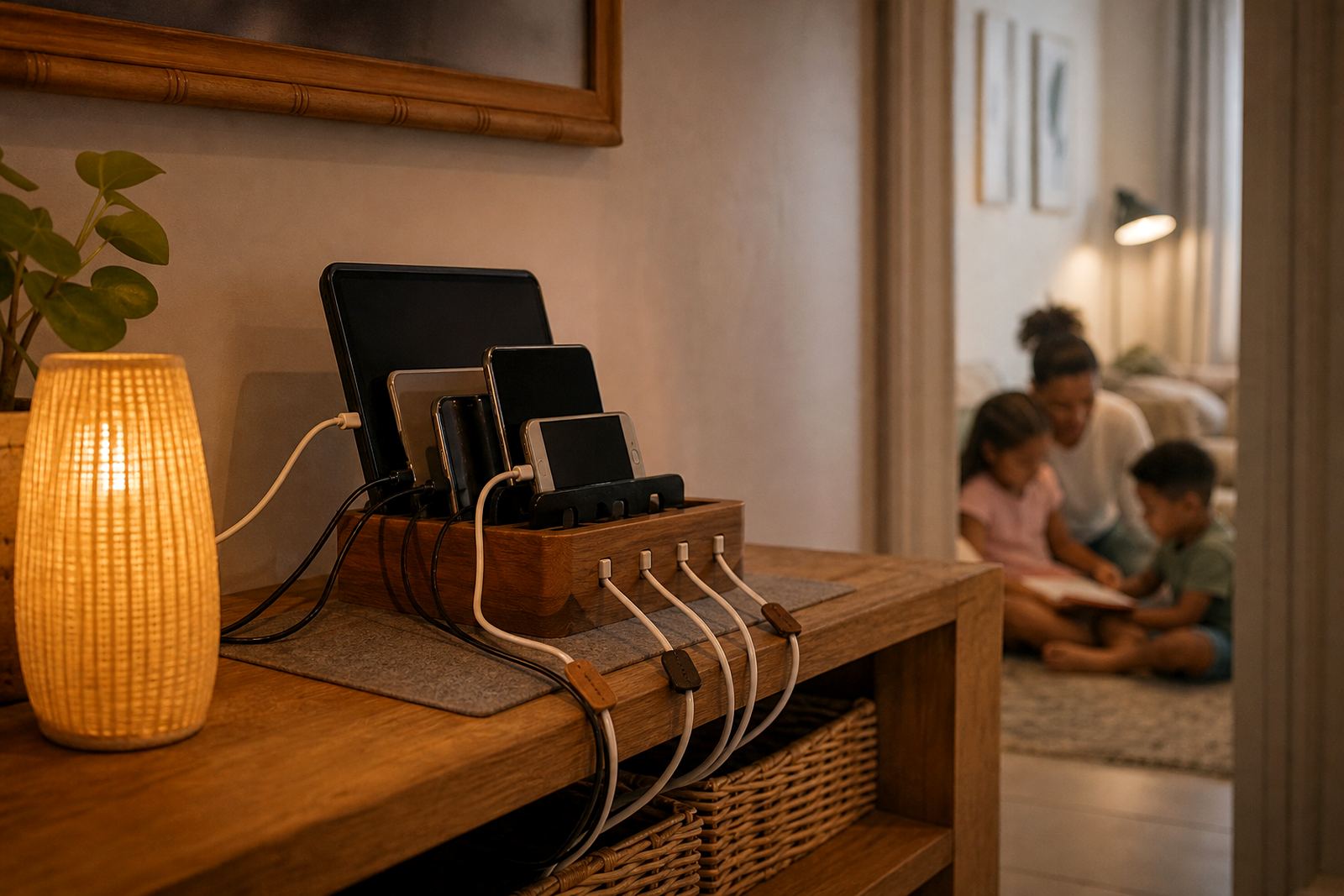
One of the simplest overnight habits is to keep charging in a shared area, not under the pillow or next to the bed. That removes the temptation to scroll after lights out and it also lowers the chance of a device getting knocked off the bed, buried under blankets or left on charge in a hot room.
Phones and tablets should be charged on a stable surface with enough airflow, and not covered by clothes, bedding or cushions.
- Pick one charging basket, shelf or counter for all family devices.
- Keep chargers out of bedrooms where possible.
- Set a fixed time for devices to go onto charge.
- Check that each child knows where their phone or tablet will be in the morning.
Set a bedtime downtime window that feels realistic
Downtime means winding down before sleep instead of switching from fast-moving screen use straight into bed. For some families that may be 30 minutes, for others it could be an hour. The point is not a perfect number, but a consistent routine that children can learn.
A good bedtime window usually includes lower-energy activities such as reading, drawing, packing a school bag, or getting clothes ready for the next day. Families with younger children may want the window to begin after supper. Families with teenagers may need a later cut-off, but still a clear one. If the rule changes every night, children will push back more often and parents will end up repeating themselves all evening.
It often helps to say what happens next, not only what must stop. For example: "At 7:30 the phones go on charge, then we get ready for bed." That simple structure gives the family something to move towards.
Keep bedtime rules fair for different ages
One rule for every child does not always work. A Grade 2 child, a teenager and a parent who uses a phone for work all have different needs. The better approach is fairness, not identical treatment. Fairness means each person has a rule that fits their age, responsibilities and sleeping routine.
When siblings share a room, bedtime rules need a bit more care. One child may fall asleep quickly while the other still wants to chat or listen to something on a device. In that situation, use headphones only if they are part of the agreement and keep volume low enough not to disturb the other child. If there is constant arguing, the rule may need to include no shared videos after a certain hour, because shared viewing often keeps everyone awake longer.
- Younger children often need a simple, visual rule they can remember.
- Teens usually respond better when they help shape the plan.
- Children with shared bedrooms may need quieter routines than those with their own room.
- Adults should follow the same bedtime habits where practical, because children notice double standards quickly.
Use device settings to support the family plan
Parental controls and screen-time limits work best when they back up a family agreement, not replace it. A device setting can help with app cut-offs, scheduled downtime and bedtime reminders, but the family still needs a clear reason for the rule. If the child understands the plan, there is less need for nightly debate.
Most families will benefit from simple controls such as app time limits, do-not-disturb hours and approval for new downloads. For bedtime, the useful part is usually the evening lock or downtime setting that reduces access after a set hour. That does not solve every problem, but it does make the rule easier to follow when everyone is tired. Parents should review the settings once in a while especially when school terms change, sports schedules shift or a child starts using a new device.
Screen-time coaching can also be useful when parents want a practical way to explain the rule without turning every evening into a lecture. The aim is to build a pattern the family can keep, not to win an argument on a school night.
Make the rule work on ordinary South African evenings
Bedtime planning is easier when it fits real life. A family in Cape Town may be dealing with a later dinner after traffic, while a household in Pretoria may be working around extra-curriculars and homework. In Bloemfontein, winter evenings can mean earlier darkness and a natural cue to slow down. The details differ, but the principle stays the same: keep the night predictable.
A local example is a Durbanville family that sets devices to charge in the kitchen at 8 pm on school nights. One parent checks homework, another makes sure water bottles and uniforms are ready, and the children know that after the phones are parked there is no more social media or gaming until morning. On weekends the rule is looser, but there is still an agreed cut-off. The family says the routine works best because everyone knows what to expect and nobody is left negotiating every night.
If your household includes grandparents, co-parents or different homes, write the bedtime rule down and keep it plain. That way the same expectation can be followed at both houses or during visits. Families do not need a long list, just a clear plan that everyone can remember.
Keep the tone calm when the rule is challenged
Even a good bedtime rule will be tested sometimes. A child may say they need the phone for one more homework message, or a teen may claim that everyone else stays online later. Calm consistency matters here. If the rule only changes after an argument, the argument becomes part of the routine.
Try to keep the wording short and steady: "The phone goes on charge now" or "The screen time is done for tonight". Then move on to the next part of the evening. If there is a genuine exception, explain it clearly and return to the normal rule the following night.
For families who need help putting the plan together, a family media plan session can turn a vague idea into a practical routine. The point is not perfection. It is to make evenings calmer, and to help everyone know where the devices are going at night.